Contract, liberty and the modern state · 1770s onward
Nations and nationalism
Overview
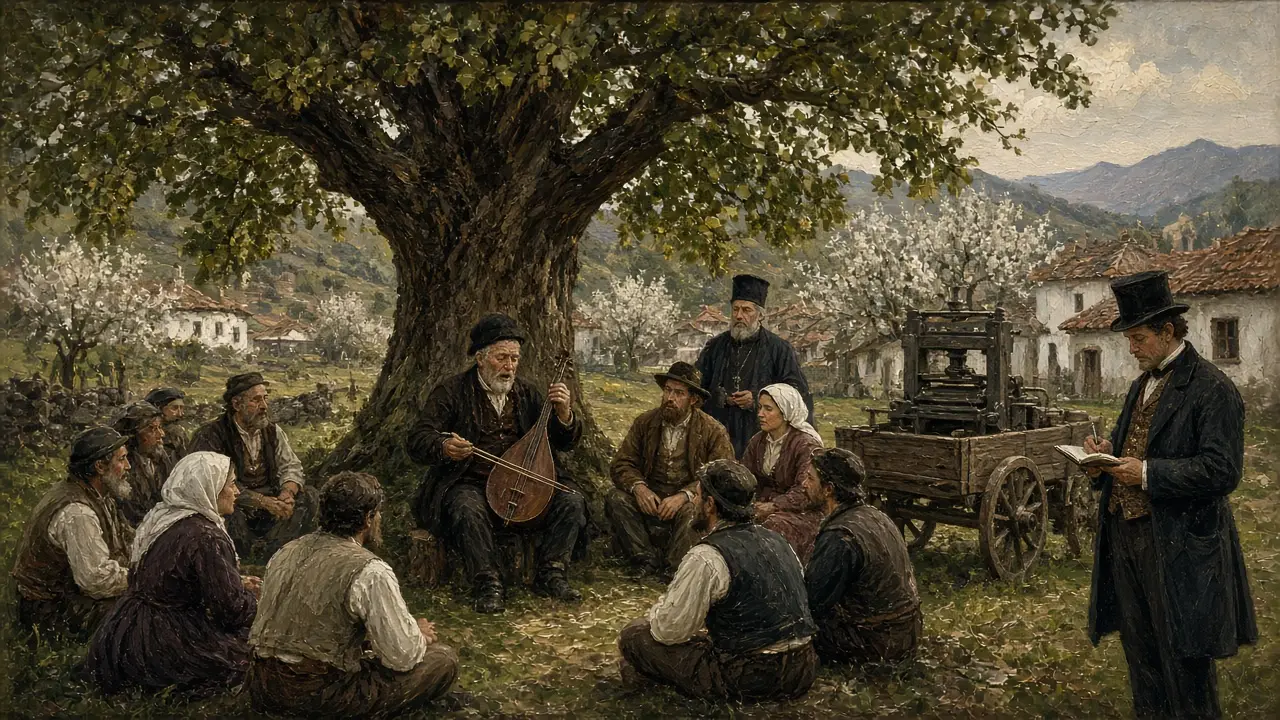
A people sharing language, memory, and culture forms a nation that should govern itself. Herder celebrated the diversity of peoples, Mazzini made the nation a moral mission, Renan called it a daily plebiscite of will, while Anderson and Gellner explained it as a modern invention made possible by print and industry.
Nationalism holds that humanity is divided into nations, each with its own culture and character, and that each nation should govern itself. It emerged in Europe in the late eighteenth century, when Johann Gottfried Herder argued that every people, or Volk, expressed a distinct spirit in its language and songs, and when the French Revolution declared that sovereignty belonged to the nation. In the nineteenth century Giuseppe Mazzini made the nation a moral mission and inspired movements across Italy, Germany, Poland, and Hungary. Ernest Renan, lecturing in Paris in 1882, defined the nation by shared memory and consent. In the twentieth century the idea spread worldwide and dissolved the colonial empires.
Read more (2 more paragraphs)
Herder held that cultures are plural and incommensurable, so that no empire should impose one language on many peoples. Mazzini taught that nations were God’s design for human association and that each had duties to humanity, so that Italian unity and the freedom of other peoples were one cause. Renan rejected race, language, and geography as the foundation of nations and insisted instead on a daily plebiscite of will. Benedict Anderson’s Imagined Communities explained how print capitalism let strangers imagine themselves as one people. Ernest Gellner argued that nationalism is the principle that the national and the political unit should be congruent, and that industrial society, needing a mobile and literate workforce, produced it.
Critics hold nationalism responsible for the wars of the twentieth century, for ethnic cleansing, and for the exclusion of minorities who do not fit the national story. Marxists call it a device for hiding class conflict, liberals fear it subordinates individuals to the collective, and cosmopolitans ask why birthplace should determine rights. Historians add that most national traditions were invented recently and then projected onto the past. Defenders reply that nations are the only communities that have made large-scale democracy and welfare states work, and that self-determination freed colonised peoples. The habit worth keeping: when someone speaks of the nation, ask who is included, who is left out, and who decided.
Where it answers
Who should decide?
A people sharing a language, memory and will to live together should govern itself, free from rule by outsiders who do not share its life.
Why obey?
A rule binds because it is the nation's own, expressing the shared culture and daily consent of a people who have chosen to be one.
What is freedom?
Freedom is a people governing itself in its own language and country, rather than being administered by strangers.
What do we owe strangers?
We owe the deepest duties to our own nation, and other nations the respect of the same right to govern themselves.
See how other traditions answer “What do we owe strangers?” →
Key terms
- Volk
- Herder’s word for a people whose spirit lives in its language, songs, and customs.
- Self-determination
- The claim that each nation has the right to its own state.
- Daily plebiscite
- Renan’s metaphor for the nation as a continuing act of consent, not a fact of blood or soil.
- Imagined community
- Anderson’s term for a nation whose members feel kinship with strangers they will never meet.
- Civic nationalism
- Membership defined by shared citizenship and laws rather than by descent or culture.
In their words
“Nationalism is primarily a political principle, which holds that the political and the national unit should be congruent.”
Further reading
- What Is a Nation? · Ernest Renan
- Imagined Communities · Benedict Anderson
- Nations and Nationalism · Ernest Gellner
Learn this
3 lessons on the walk
Related traditions
Influenced by
Influenced

Disagrees with
In this tradition


Compare
Cite or share this page
A plain reference you can paste into notes or an essay:
Quest2Order. “Nations and nationalism.” https://quest2order.com/learn/ideas/nationalism. Accessed 29 November 2026.