Ancient Greece and Rome · 509 to 27 BCE
Roman republicanism
Overview
Liberty survives only where power is divided and each part can check the others. Polybius credited Rome’s success to a constitution that mixed consuls, senate and people; Cicero made the republic the common property of its citizens under a law of reason. The fall of the Gracchi showed what happens when the checks give way to violence.
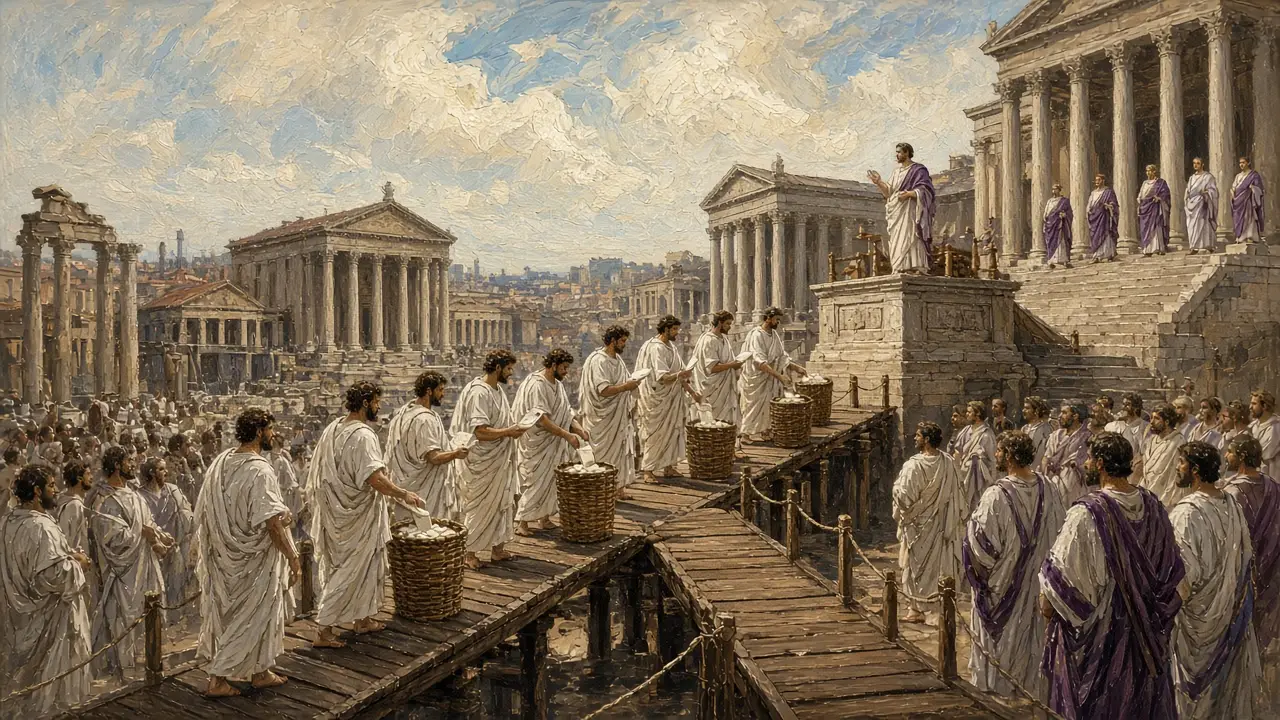
Roman republicanism is the body of thought that grew out of the Roman Republic, the regime that governed Rome from the expulsion of the kings, traditionally dated to 509 BCE, until Augustus took sole power in 27 BCE. Its writers were less interested in the ideal state than in explaining why a particular one had survived and conquered. The Greek historian Polybius, held in Rome as a hostage in the second century BCE, concluded that Rome had stumbled into a mixed constitution in which consuls, senate and popular assemblies checked one another. Cicero and Livy, writing as the Republic collapsed, turned that account into a civic creed.
Read more (2 more paragraphs)
The central idea is that liberty depends on no one holding unchecked power. Polybius argued that monarchy, aristocracy and democracy each decay on their own, but balanced together they hold. Cicero, in On the Republic and On the Laws, defined the res publica as the property of the people, bound by a law of reason that no assembly could repeal. Livy filled his History of Rome with examples of civic virtue meant to shame his own generation. The brothers Tiberius and Gaius Gracchus, tribunes in 133 and 123 BCE, pushed land reform through the assemblies against the senate and were killed for it, a case later republicans read as a warning about faction.
Critics began early. Sallust and Tacitus thought the Republic had been an oligarchy whose liberty belonged to a few families, and that its civil wars showed a mixed constitution cannot survive extreme inequality and private armies. Modern historians add that the celebrated balance rested on slavery, conquest and the exclusion of women and most Italians from citizenship. Others note that Polybius’s neat cycle of regimes fits the evidence poorly. Yet the Roman vocabulary of checks, vetoes, term limits and civic duty passed through the Renaissance into the constitutions of the modern world. The habit worth keeping: ask of any office not only who holds it but who can stop it.
Where it answers
Who should decide?
The people elect magistrates and pass laws, while the Senate's counsel and the consuls' command keep any one faction from ruling alone.
Why obey?
A law binds because the people passed it and custom has tested it, and because the republic's liberty depends on magistrates obeying it too.
What is freedom?
Freedom is the standing of a citizen under law, protected by tribunes, appeal and the veto from the arbitrary will of any magistrate.
What do we owe strangers?
We owe strangers the law of nations, the rules reason finds common to all peoples, and in time a share of citizenship itself.
See how other traditions answer “What do we owe strangers?” →
Key terms
- Mixed constitution
- A regime blending monarchy, aristocracy and democracy so each element restrains the others; Polybius’s explanation of Rome’s stability.
- Tribune
- Officer elected by the plebeians to protect them, with the power to block any magistrate or act of the senate.
- Veto
- Latin for ‘I forbid’; a tribune or consul could halt public business by saying it.
- Res publica
- The ‘public thing’; for Cicero, the property of the people, not of any ruler or faction.
- Senate
- Council of former magistrates that advised, controlled finance and foreign policy, and dominated the Republic in practice.
In their words
“Salus populi suprema lex esto — let the safety of the people be the highest law.”
Further reading
- Histories · Polybius
- On the Republic · Cicero
- History of Rome · Livy
Learn this
Related traditions
Influenced by

Influenced


In this tradition
Compare
Cite or share this page
A plain reference you can paste into notes or an essay:
Quest2Order. “Roman republicanism.” https://quest2order.com/learn/ideas/rome. Accessed 29 November 2026.