
Lesson · 6 min Steady
Arendt on Totalitarianism
In one line Arendt saw totalitarianism as new: a movement that cuts every tie between people and rules by ideology and terror.
Hannah Arendt, a German Jewish scholar who fled the Nazis in 1933 and reached New York in 1941, published The Origins of Totalitarianism in 1951. Her claim was that Nazi Germany and the Soviet Union under Stalin were not simply old tyrannies with new weapons. They were a new form of rule, and the old words, despotism or dictatorship, hid what was new about them.
A tyrant, Arendt said, wants obedience and leaves his subjects alone in private. A totalitarian movement wants the whole person. It breaks every bond that does not run through itself: parties, unions, churches, clubs, and in the end friendships and families, where a child might report a parent. In place of law it puts ideology, the claim to know the law of Nature or of History by which some races or classes are doomed, and terror carries out the verdict. So terror grows after the opposition is gone, falling on people for what they are rather than for anything they did. The camps were its laboratory, where she thought the regime tested whether human beings could be made interchangeable.
Such movements fed on masses: people torn loose by war, inflation and unemployment from the classes and communities that once gave them a place. Arendt's key word was loneliness, the sense of belonging nowhere, which makes a movement's iron logic feel like a home. Hence her remedy. The defence is a shared public world where people meet as equals, speak and act together: councils, clubs, and the associations Tocqueville admired in American towns. Her later book The Human Condition (1958) made such action the heart of politics.
Critics answer that she placed two very different regimes in one box, and historians of the Soviet Union later found more everyday bargaining and less isolation than her model allows. Defenders reply that a model shows a direction, not a finished fact.
The room in the shared flat
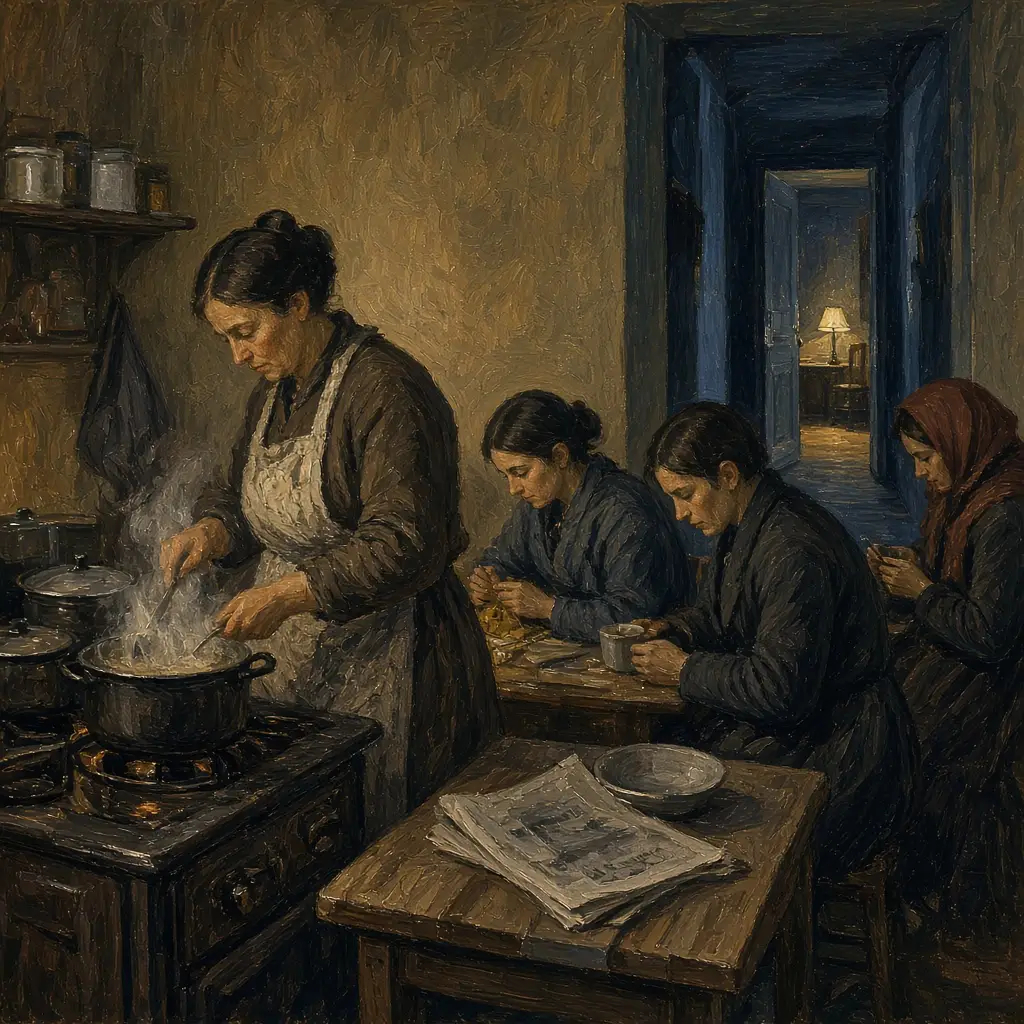
Lidia lived with her husband and daughter in one room of a communal flat in Moscow, sharing the kitchen with four other families. In the spring of 1937 a neighbour, an engineer, was taken away at night. Nobody in the kitchen spoke of it. The next week his wife and son were moved out and a new family moved in. Lidia stopped going to the reading circle she had joined at the factory club, because she could no longer be sure who in it was listening.
By the winter she and her husband no longer talked about politics even in their own room, in case their daughter repeated something at school. Nobody had threatened her. She had simply arrived, one careful step at a time, at a life in which she trusted no one, and in which the voice of the newspaper was the only one left in the room.
Try this today Name one thing you only ever discuss with people you know face to face, and ask what would be lost if that circle vanished.
Cite or share this lesson
A plain reference you can paste into notes or an essay:
Quest2Order. “Arendt on Totalitarianism.” https://quest2order.com/learn/lesson/arendt-origins-of-totalitarianism. Accessed 29 November 2026.
Sources
- Hannah Arendt — Stanford Encyclopedia of Philosophy on totalitarianism, plurality and action.
- The Origins of Totalitarianism — The 1951 book, its three parts and its critics.