Lesson · 6 min Steady
Bakunin's Warning
In one line Bakunin warned that a workers' state would breed a new ruling class, and that the state itself was the danger.
Mikhail Bakunin, a Russian nobleman turned revolutionary, spent years in tsarist fortresses and Siberian exile before escaping in 1861 by way of Japan and America. He shared Marx's goal of a world without classes and joined the International Workingmen's Association, in which Marx was a leading figure. In 1867, in a proposal to a peace congress in Geneva, he set out a principle quoted ever since: 'liberty without socialism is privilege, injustice', and 'socialism without liberty is slavery and brutality'.
The quarrel with Marx was over the road. Marx expected workers to win political power and use the state, for a time, to remake the economy. Bakunin predicted how that would go wrong. In Statism and Anarchy (1873) he argued that a people's state would be run by elected workers who, once in office, would stop being workers and look down on the people from the heights of the state, joined by educated socialists sure they knew best. A new ruling class would replace the old. Better to abolish the state and let free associations of workers and communes federate from below. At the International's congress at The Hague in 1872, Marx's supporters had Bakunin expelled, and the movement split.
Many later read the twentieth century as his vindication. Milovan Djilas, once among the most senior leaders of communist Yugoslavia, argued in The New Class (1957) that party officials had become a privileged class of their own, and he was jailed for saying so.
The reply is that order without a state has rarely lasted. In Catalonia and Aragon after 1936, anarchist unions collectivised factories and farms, but the collectives relied on militias, some pressed reluctant neighbours, and they were broken by their Republican allies and then by Franco's victory. As When the State Is Absent showed, where no state rules, armed groups compete to become one. Anarchists answer that their experiments were short because states crushed them, not because they failed.
The deputy and the strike

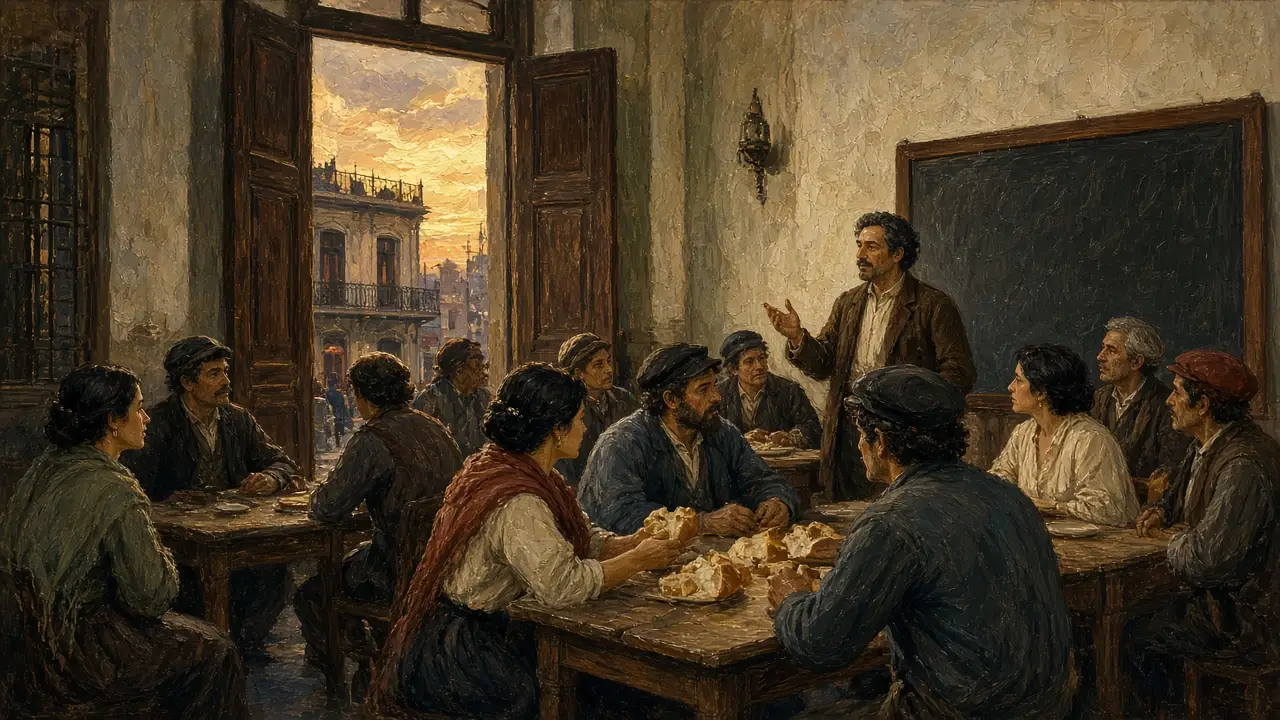
In 1904 Teresa rolls cigars in a workshop in Buenos Aires and belongs to a union federation led by anarchists. That year a socialist lawyer has been elected to Argentina's congress, and he promises laws on Sunday rest and on women's and children's work. Some of Teresa's workmates want the union to back his side at the next election.
The anarchist speaker at the evening meeting will have none of it. Send our best people to congress, he says, and in five years they will be men of congress, not of the workshop. What we win, we win by striking. Teresa has seen strikes win shorter hours, and has seen the police break them too. She leaves the hall unsure whether the deputy's law or the union's strength will protect her first, and suspecting she will need both.
Try this today Think of someone who took power promising to give it back once the job was done, and check whether they did.
Cite or share this lesson
A plain reference you can paste into notes or an essay:
Quest2Order. “Bakunin's Warning.” https://quest2order.com/learn/lesson/bakunin-against-the-state. Accessed 29 November 2026.
Sources
- Anarchism — Stanford Encyclopedia of Philosophy on anarchist thought, Bakunin, and the objection that anarchy drifts back into the state.
- Hague Congress (1872) — The congress of the International that expelled Bakunin and split the movement.
- Federalism, Socialism, Anti-Theologism — Bakunin's 1867 proposal to the League for Peace and Freedom, with the lines on liberty and socialism.