Lesson · 6 min Steady
The Examination Hall
In one line China chose officials by written exams for thirteen centuries, opening careers to talent but narrowing what talent meant.
How do you staff a vast state with officials who are able, and loyal to the state rather than to their own families? The Sui dynasty, which reunited China in 589, began choosing some officials by written examination, and the Tang continued the practice. Under the Song, from the tenth century, the examinations became the main road to high office.
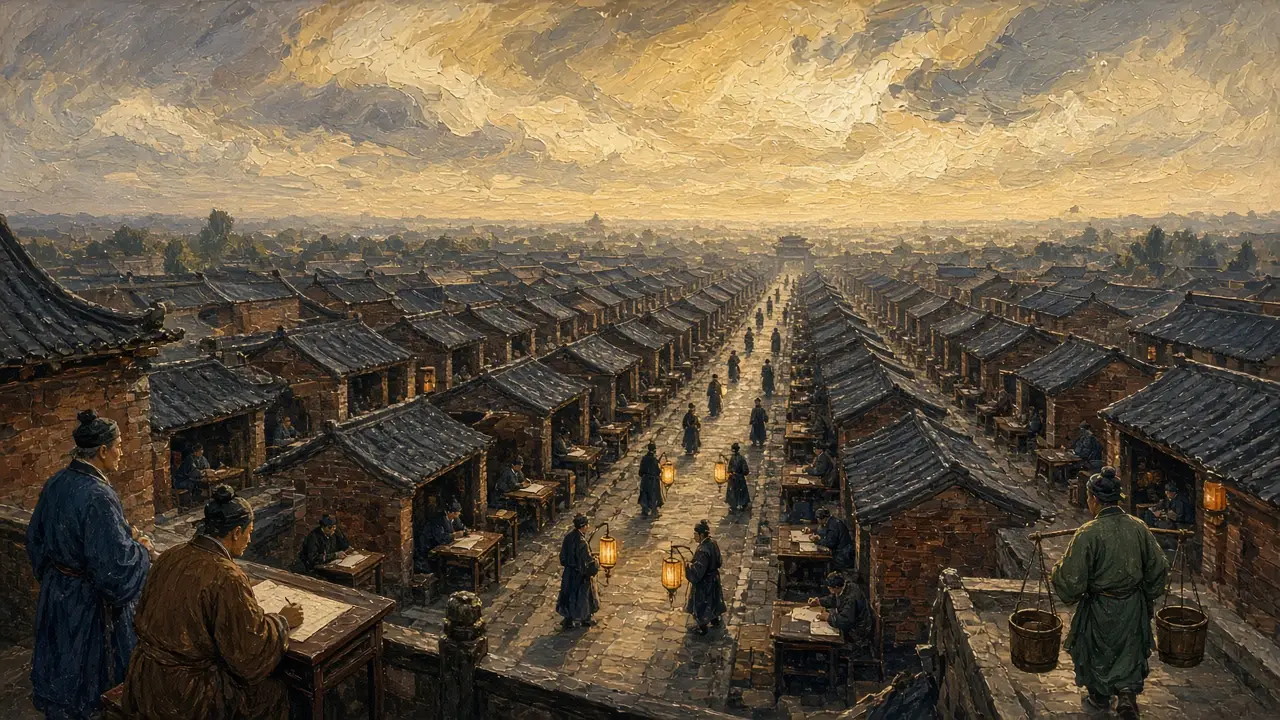
The system was built for fairness. Candidates sat for days in rows of small cells, with one plank for a desk and another for a bed. Under the Song, names on the papers were covered and clerks recopied each answer so that examiners could not recognise the handwriting. Those who passed local tests went on to provincial and metropolitan examinations, and a final round was held at the palace. Success could lift a family from obscurity, and lineages pooled money to school a promising boy. Korea and Vietnam built examinations on the Chinese model, and in the nineteenth century, as Permanent or Appointed? told, British reformers turned to examinations too.
The examinations also narrowed what counted as talent. The subject was the Confucian classics and the commentaries the state approved. Under the Ming, answers came to follow a rigid form, the eight-legged essay. Years of memorising suited sons of families who could spare them from work; women were barred entirely; most candidates failed again and again. Officials shared one training and one outlook, which made them a united class but not always an inventive one.
The Qing abolished the system in 1905, after reformers argued that it could not produce the engineers and officers a modern state needed. The tension it carried, that any fair test also decides what kind of person succeeds, has not gone away.
Go deeper
The examinations were never the only road, nor perfectly fair. Under the Song, sons of high officials could enter office through family privilege, and late in the Qing the state sold degrees to raise money. Yet the historian Ping-ti Ho, studying lists of successful candidates under the Ming and Qing, found that a large share came from families with no degree-holders in the three generations before them. Korea held its examinations from the tenth century until 1894. Hong Xiuquan, who failed the examinations several times, went on to lead the Taiping rebellion, a reminder that people a system shuts out do not always go quietly home.
Cell number forty

Wenbo, the son of farmers near Suzhou, entered the examination compound in Nanjing with a basket of rice cakes, ink, brushes and a quilt. Guards searched his sleeves for notes before he was shut into his cell. At the gate a broker had whispered an offer: for a price, an examiner would watch for a certain phrase in the opening lines and mark that paper kindly.
Wenbo wrote his essay on a passage from the Analects in the required form, eight balanced sections, and left the phrase out. His name was sealed under paper, and clerks recopied his answer in red ink so no one would know his hand. When the list was posted weeks later his name was not on it, nor were the names of most of the thousands who had sat beside him. He went home to study for three more years. He thought the test was narrow. He also thought it was the one door in the province that did not ask who his father was.
Try this today Think of a test you once took that decided a place or a job, and ask what kinds of ability it could not see.
Cite or share this lesson
A plain reference you can paste into notes or an essay:
Quest2Order. “The Examination Hall.” https://quest2order.com/learn/lesson/imperial-examination-system. Accessed 29 November 2026.
Sources
- Imperial examination — The history of China's examinations from the Sui to 1905, and their spread to Korea and Vietnam.
- Temple of Literature, Hanoi — The temple whose stone tablets honour the graduates of Vietnam's highest examinations.