
Lesson · 6 min Steady
The Great Law of Peace
In one line The Haudenosaunee bound several nations in one league, with leaders the clan mothers could choose and remove.
South of Lake Ontario, five nations, the Mohawk, Oneida, Onondaga, Cayuga and Seneca, joined long ago in a confederacy. They call themselves the Haudenosaunee, the people of the longhouse; the French called them the Iroquois. In their tradition a messenger known as the Peacemaker, with Hiawatha, persuaded the warring nations to bury their weapons beneath a great white pine, the Tree of Peace. When this happened is debated: estimates run from the twelfth century to the sixteenth. The Tuscarora joined in the 1700s, making six nations.
The Great Law of Peace, kept in memory and in wampum belts, builds the league from the family upward. Each nation keeps its own council and runs its own affairs. Matters touching all go to the Grand Council of fifty chiefs at Onondaga. Clan mothers, the senior women of each clan, hold the chiefly titles: they choose a chief, counsel him and, after warnings, can remove him. Decisions are reached by consensus. The Mohawk and Seneca deliberate first and pass their view to the Oneida and Cayuga; the Onondaga, keepers of the fire, confirm the result or send it back.
That is a federation with checks: power shared between nations and council, leaders answerable to those who chose them, and no decision without broad agreement. It took shape before any contact with European political writing.
Did it shape later constitutions? Benjamin Franklin knew the League, and in 1751 wrote that if six Native nations could keep a union, the colonies surely could. In 1988 the United States Congress passed a resolution acknowledging the Confederacy's contribution. Many Haudenosaunee and some historians see a real influence. Others, such as the anthropologist Elisabeth Tooker, find little trace of it in the debates of 1787 and stress how different the two systems are. The evidence is still argued over.
Go deeper
The clan mothers' powers drew notice far beyond the nations. The ethnologist Lewis Henry Morgan described the League in detail in 1851, working closely with the Seneca scholar Ely S. Parker. Later in the century the American suffragist Matilda Joslyn Gage pointed to Haudenosaunee women's authority as proof that women's political power was neither new nor unnatural. Haudenosaunee writers today stress that the Great Law is a living constitution, not only a historical document, and that the Grand Council at Onondaga still meets.
The belt at Ganondagan
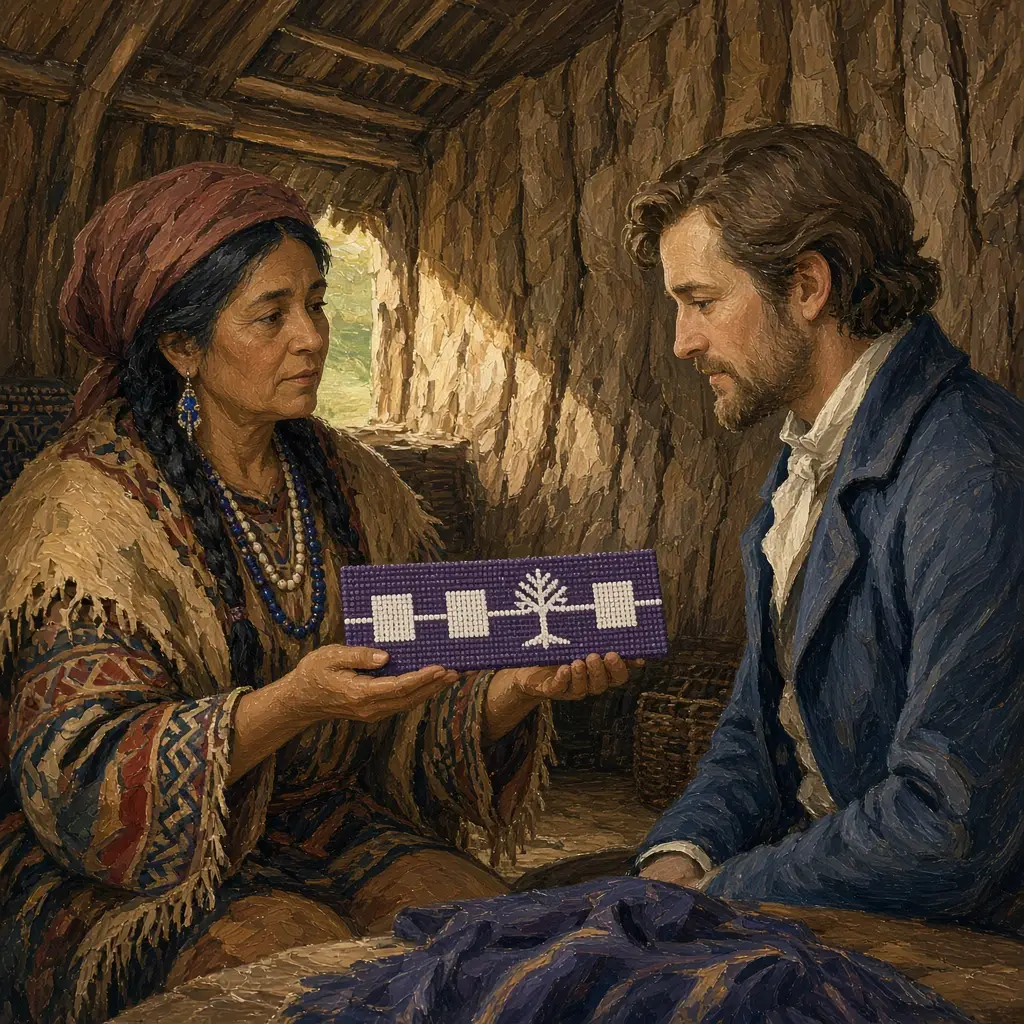
Mateo teaches civics at a secondary school in Bogotá. Visiting relatives in New York State, he spent an afternoon at Ganondagan, the site of a seventeenth-century Seneca town near Rochester. In the reconstructed bark longhouse, a Seneca guide showed a copy of the Hiawatha Belt: four squares and a tree in white beads on purple, the nations joined by a single line.
Mateo asked how the chiefs were chosen. The guide explained the clan mothers' role, and that a chief who ignored their warnings could lose his title. Mateo thought of his own lesson plan on federations, which began in Philadelphia in 1787 and stayed there. On the flight home he rewrote it to open with the belt, and added a question for his class: what would change if the people who nominated a leader could also remove him?
Try this today Find out how the leader of a group you belong to can be removed. Ask who holds that power and whether it has ever been used.
Cite or share this lesson
A plain reference you can paste into notes or an essay:
Quest2Order. “The Great Law of Peace.” https://quest2order.com/learn/lesson/iroquois-great-law-of-peace. Accessed 29 November 2026.
Sources
- Great Law of Peace — The founding story, the structure of the Grand Council and the debate over influence.
- Haudenosaunee Confederacy — The Confederacy's own site, with its account of the Great Law and the council.