
Lesson · 6 min Stretch
The Perils of Presidentialism
In one line Linz blamed the design of presidential systems for democratic breakdown; his critics blamed what came before them.
Presidential democracies break down more easily than parliamentary ones, and the design itself is partly to blame. That was the warning of the Spanish political scientist Juan Linz, on which the lesson Ambition Against Ambition closed. In The Perils of Presidentialism, published in the first issue of the Journal of Democracy in 1990, he set it out in full.
He gave three main reasons. First, dual legitimacy: president and congress are both elected, so when they clash each can say it speaks for the people, and no principle settles who is right. Second, rigidity: a fixed term cannot be cut short when a president loses support, except by impeachment or worse. Third, winner-take-all: one office cannot be shared, so the losers are shut out of the executive for years and every election raises the stakes. His evidence came from Latin America, where presidential democracies fell to coups in Brazil in 1964, in Chile and Uruguay in 1973 and in Argentina in 1976, while the United States was the unusual long survivor.
Replies came quickly. Donald Horowitz answered in the same journal that Linz had drawn his cases from one region, and that parliamentary systems with winner-take-all elections had also broken down, in Africa and Asia; electoral rules mattered as much as the executive. Later José Antonio Cheibub tested the claim on democracies since the Second World War. Presidential democracies did die younger, he found, but chiefly because they tended to follow military dictatorships, and democracies born from military rule are fragile whatever their design.
Both sides hold real ground. Linz's mechanisms appear whenever a president and congress lock horns with no exit. His critics show that many presidential democracies last, and that a country's past may matter more than its constitution. Later weeks on breakdown will put both to the test.
Go deeper
Linz knew breakdown at first hand. Born in Bonn in 1926 to a Spanish mother, he grew up in Spain, lived through its civil war as a boy, and spent much of his career at Yale studying how democracies die and how dictatorships end. He first made his name by separating authoritarian regimes, which leave parts of life alone, from totalitarian ones, which try to control everything. His case for parliamentary government grew from the same question: which institutions give politicians a way out of a crisis short of force.
Who decides now?
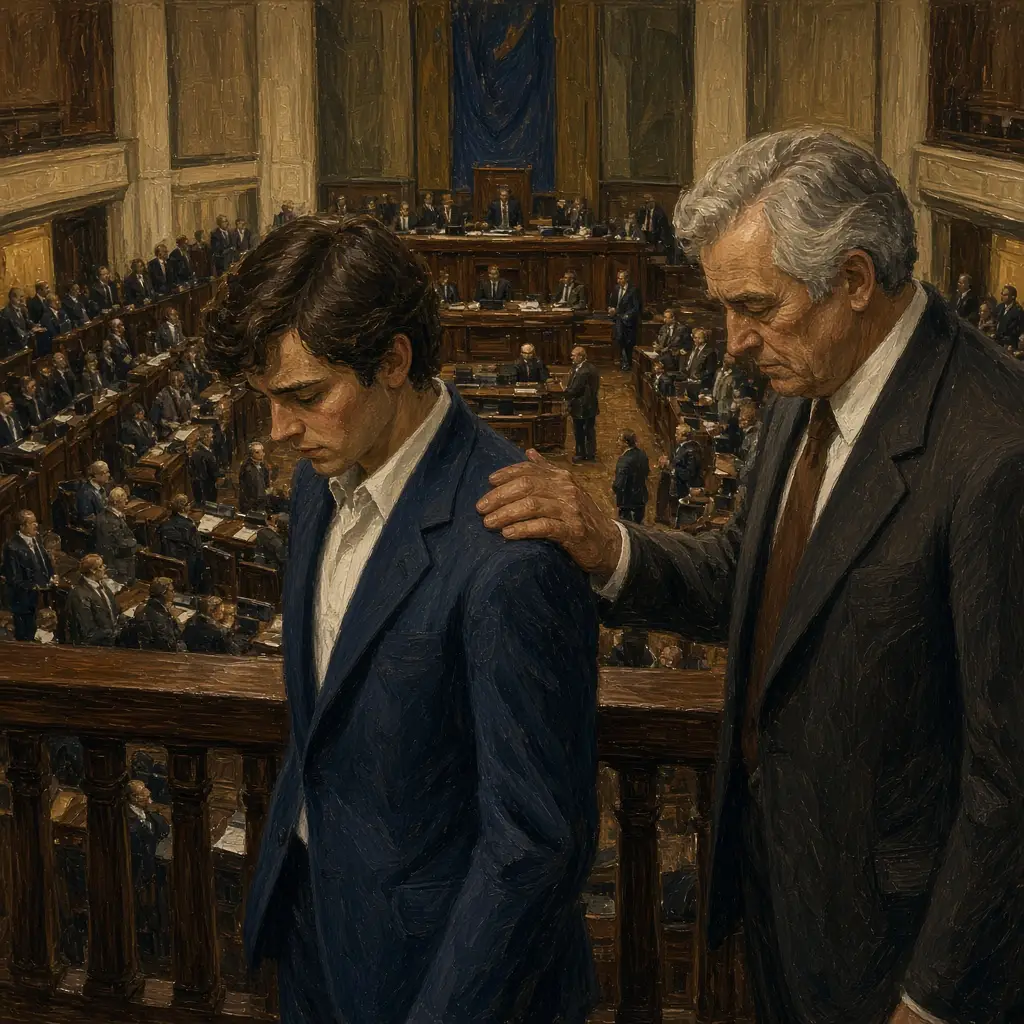
In August 1973 Patricio, a law student in Santiago, sat in the public gallery of the Chamber of Deputies as a majority voted a resolution accusing the president's government of breaking the constitution. The president replied that the chamber had no power to judge him that way, and that his term still had three years to run. Patricio's professor, walking out beside him, asked a question he never forgot: who decides now?
Less than three weeks later the armed forces answered it, with tanks around the presidential palace. Years afterwards, teaching in Montevideo, Patricio told his students that the coup was the generals' choice and that no constitution forced it. But he also told them about the gallery, and the two mandates facing each other with nowhere to go, and he let them weigh both stories.
Try this today Pick a democracy that broke down. Was its executive presidential or parliamentary, and who ruled before it?
Cite or share this lesson
A plain reference you can paste into notes or an essay:
Quest2Order. “The Perils of Presidentialism.” https://quest2order.com/learn/lesson/linz-perils-of-presidentialism. Accessed 29 November 2026.
Sources
- The Perils of Presidentialism — Linz's essay, Journal of Democracy, volume 1, issue 1, Winter 1990.
- Juan José Linz — His life, from Bonn and Spain to Yale, and his work on regimes and presidentialism.
- Presidential system — Linz's critique of fixed terms and zero-sum elections, with the main defences of the design.