Lesson · 6 min Steady
Marx on Alienation
In one line Marx argued that a worker can be free by contract yet unfree for most of the waking day, a stranger to his own work.
In 1844 a young German exile in Paris, Karl Marx, filled notebooks on economics and philosophy that appeared in print only in 1932, as the Economic and Philosophic Manuscripts. Their central idea is alienation, or estrangement: the way a working life can become foreign to the person living it.
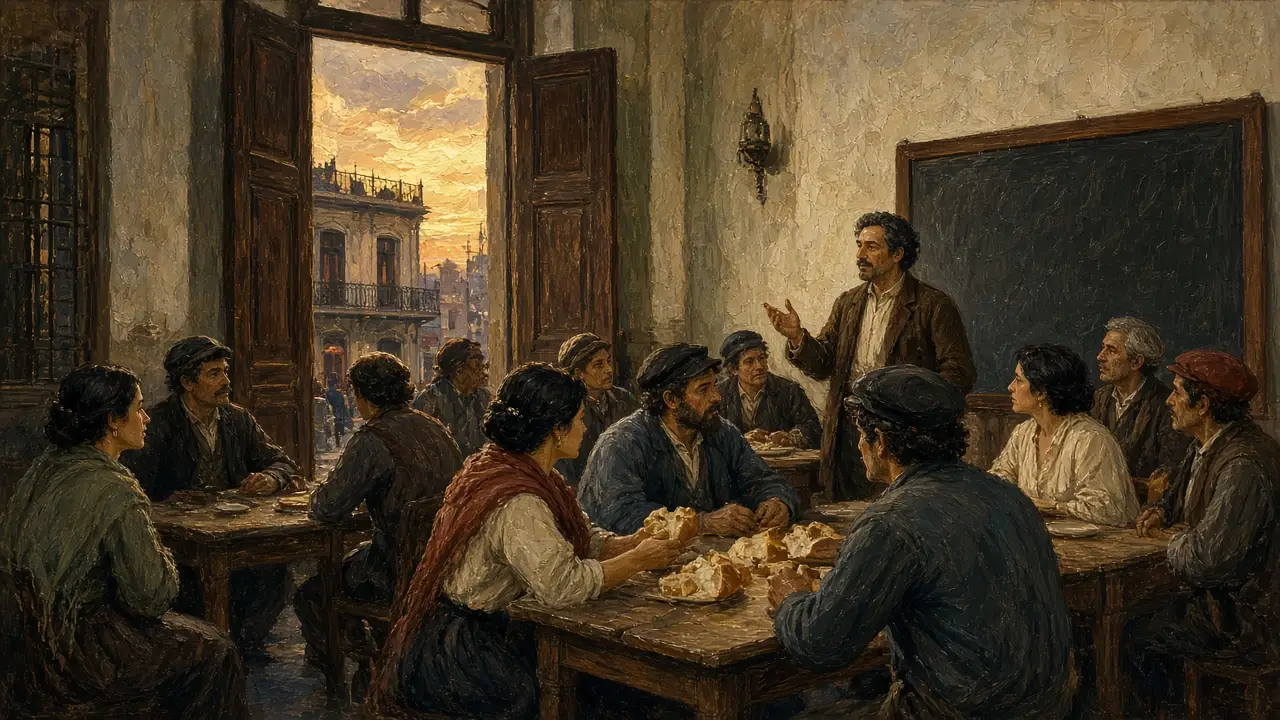
Marx described four sides of it under wage labour. The product belongs to someone else and stands over the worker as an alien power. The activity is not his either: he works because he must, at a pace and in a manner others set. He is cut off from what Marx thought most human, shaping the world freely and with purpose. And he meets other people mainly as rivals or masters. So, in one translation, the worker 'feels at home when he is not working, and when he is working he does not feel at home.'
This is Marx's reply to the liberty tradition, before any talk of revolution. Locke had said that mixing your labour with something makes it yours, as Locke's Right to Resist showed. Marx asked what becomes of that when the labour itself is sold. Nobody forces the worker to sign. Yet for most of his waking hours he does as he is told, and he cannot easily refuse, because the alternative is hunger. Liberty on paper can sit beside a daily life of unfreedom.
Critics answer that many people find pride, skill and friendship in their work, and that wages, unions and shorter hours have changed the picture since 1844. Alienation is hard to measure and rests on a contested view of human nature. Workers in planned economies reported boredom and powerlessness too, which suggests the cause may be large organisations as much as ownership. Whether the cure is ownership, a voice at work or more free time is a question the rest of the week takes up.
Go deeper
Because the manuscripts stayed unpublished for nearly ninety years, most early Marxists never read them. After they appeared, and especially after the Second World War, they became a favourite of writers who wanted a humane Marx, distinct from Soviet official doctrine. The French philosopher Louis Althusser replied that the mature Marx had left this language behind for a more scientific study of capitalism, while others see one thread running through his work. Sociologists later tried to measure alienation directly: Robert Blauner's Alienation and Freedom (1964) found it highest on car assembly lines and lower in craft printing and in continuous-process chemical plants, which suggested that technology and the design of work matter as well as ownership.
The door and the wall

In the 1970s Ana fits rear doors at a car plant in São Bernardo do Campo, outside São Paulo. A door arrives every ninety seconds. She has never seen a finished car leave the line, and could not say who buys them. The foreman times her breaks, and the managers redesign her job twice in a year without asking her. Her wage is better than her mother's ever was, and she is proud of what it pays for.
On Sunday she builds a wall around the family's yard with her brother, choosing the stones and arguing about where the gate should go. She works harder than on any weekday and goes home happy. At a union meeting she tries to explain the difference: it is not the effort, nor only the pay, but that on Sunday the work is hers. A younger worker shrugs. He would take a raise over a say in the job any day, he says, and Ana is not sure he is wrong.
Try this today Notice one task today that you do only for the pay, and ask what would have to change for it to feel like your own.
Cite or share this lesson
A plain reference you can paste into notes or an essay:
Quest2Order. “Marx on Alienation.” https://quest2order.com/learn/lesson/marx-alienation-and-labour. Accessed 29 November 2026.
Sources
- Estranged Labour — The 1844 manuscript section on alienated labour, in Martin Milligan's translation.
- Alienation — Stanford Encyclopedia of Philosophy on the concept, its history and the problem of measuring it.
- Marx's theory of alienation — Overview of the four estrangements and the debate over the young and mature Marx.