Lesson · 6 min Steady
Whose State Is It?
In one line The Manifesto called the state a tool of the ruling class; critics point to states that have taxed and tamed the rich.
In February 1848, weeks before revolutions swept Europe, Marx and Friedrich Engels published The Communist Manifesto in London. It opens with a sweeping claim: 'The history of all hitherto existing society is the history of class struggles.' Each age, they argued, is shaped by how its goods are produced and who owns the means of producing them. When those means change, as steam and factories changed them, a new class rises, and law and politics are rebuilt around it.
From this follows a theory of the state. 'The executive of the modern state,' the Manifesto says, 'is but a committee for managing the common affairs of the whole bourgeoisie', the owners of capital. The state is not a neutral referee above society but an instrument of the dominant class. The word whole matters: the state settles quarrels among capitalists and protects the system they share, even against particular capitalists. The Monopoly on Force, on this view, is a monopoly held for someone.
The counter-case is strong. States have often acted against the rich. Britain's Factory Acts limited working hours over many employers' protests, and Marx himself later hailed the Ten Hours Act of 1847 as a victory for workers. Bismarck's Germany built the first national social insurance in the 1880s. Land reforms in Japan, Taiwan and South Korea after the Second World War broke the power of landlords. Elections, critics say, give numbers a weapon against money.
Marxists reply that such reforms were concessions that saved the system; Bismarck openly hoped his insurance would draw workers away from the socialists. Chile is read both ways. In 1970 its voters and congress made the Marxist Salvador Allende president, and the copper mines were nationalised by law. In 1973 the armed forces overthrew him. Was the state a referee the voters had won over, or an instrument that struck back when its owners were threatened? The argument continues.
Ten hours and a fine

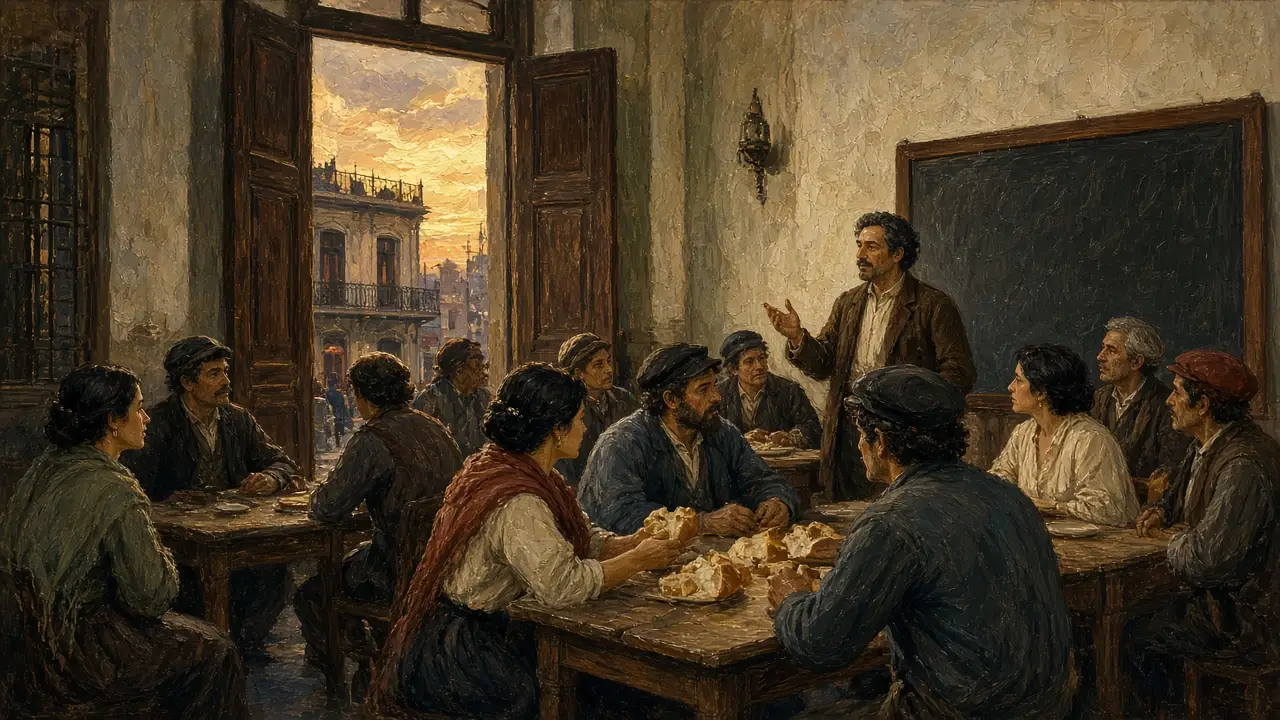
In 1847 Samuel, a cotton spinner in Manchester, hears that Parliament has passed the Ten Hours Act, limiting the working day of women and young people in the mills. Many mill owners fought it hard; landed members of Parliament with little love for the cotton masters helped vote it through. Samuel, whose daughter works the frames beside him, celebrates in the pub that evening.
A fortnight later he and others who walked out over a pay cut stand before the local bench. The magistrate owns a mill himself, and he fines them for breaking their contracts of service, which for a worker is a crime. Walking home, Samuel cannot decide which event tells him what the state is. His friend Ellen says both do: it gives ground when pressed hard enough, and holds the ground that matters. Samuel thinks the pressure that won ten hours might, in time, win more.
Try this today Pick one law that costs wealthy people money and find out who pushed for it, and whether it changed who holds power.
Cite or share this lesson
A plain reference you can paste into notes or an essay:
Quest2Order. “Whose State Is It?.” https://quest2order.com/learn/lesson/marx-class-and-the-state. Accessed 29 November 2026.
Sources
- Manifesto of the Communist Party, chapter I — Bourgeois and Proletarians, in Samuel Moore's 1888 translation, with the line on the executive of the modern state.
- Karl Marx — Stanford Encyclopedia of Philosophy on Marx's theory of history and his instrumental and later views of the state.
- Salvador Allende — His election in 1970, his programme and the coup of 11 September 1973.