
Lesson · 6 min Steady
Montesquieu's Three Powers
In one line Liberty lasts when making, carrying out and judging laws sit in different hands that can resist each other.
The power to make laws should be kept apart from the power to carry them out. Kant demanded it, as Kant's Republic of Reason showed, but the writer who gave the idea its modern shape was Charles de Secondat, Baron de Montesquieu, a judge from Bordeaux. In The Spirit of the Laws, published in 1748, he defined political liberty as a calm of mind that comes from each person's sense of being safe. That calm cannot last, he argued, where the power to make laws, the power to execute them and the power to judge sit in the same hands. In the Ottoman empire, he wrote, where the sultan held all three, the subjects lived in dreadful oppression.
Montesquieu had spent about two years in England, and he held up its constitution as his model: a Parliament that made laws, a king who executed them, judges who decided cases. He somewhat misread it. By his day the king's chief ministers sat in Parliament and needed its majority, so the first two powers were already growing together. A century later the English writer Walter Bagehot argued that this close union, not separation, was the real secret of the English system.
The misreading mattered little, because his deeper point was not about England. Dividing power is not enough; each part needs the means to resist the others. The executive should hold a veto, the legislature should be split into two houses that can block each other, and judging should be done apart, as Why Judges Keep Their Jobs showed. Power, he wrote, must be a check to power. He admitted that such powers might sit in a kind of standstill, moving only when necessity forced them to move together.
That is a design for liberty, not for speed. The rest of this week asks how to give each power the will and the weapons to resist.
Go deeper
Montesquieu did not think England's arrangement was the only road to liberty. In France he looked to what he called intermediate powers: the nobility, the towns, the clergy and above all the parlements, the high law courts that registered royal edicts and could protest against them. He had inherited a senior seat in the Parlement of Bordeaux, which he later sold. Critics said he was defending his own class. Admirers reply that his point was general: liberty needs bodies with standing of their own between the ruler and the ruled, an idea Tocqueville takes up later this week.
The parking fine
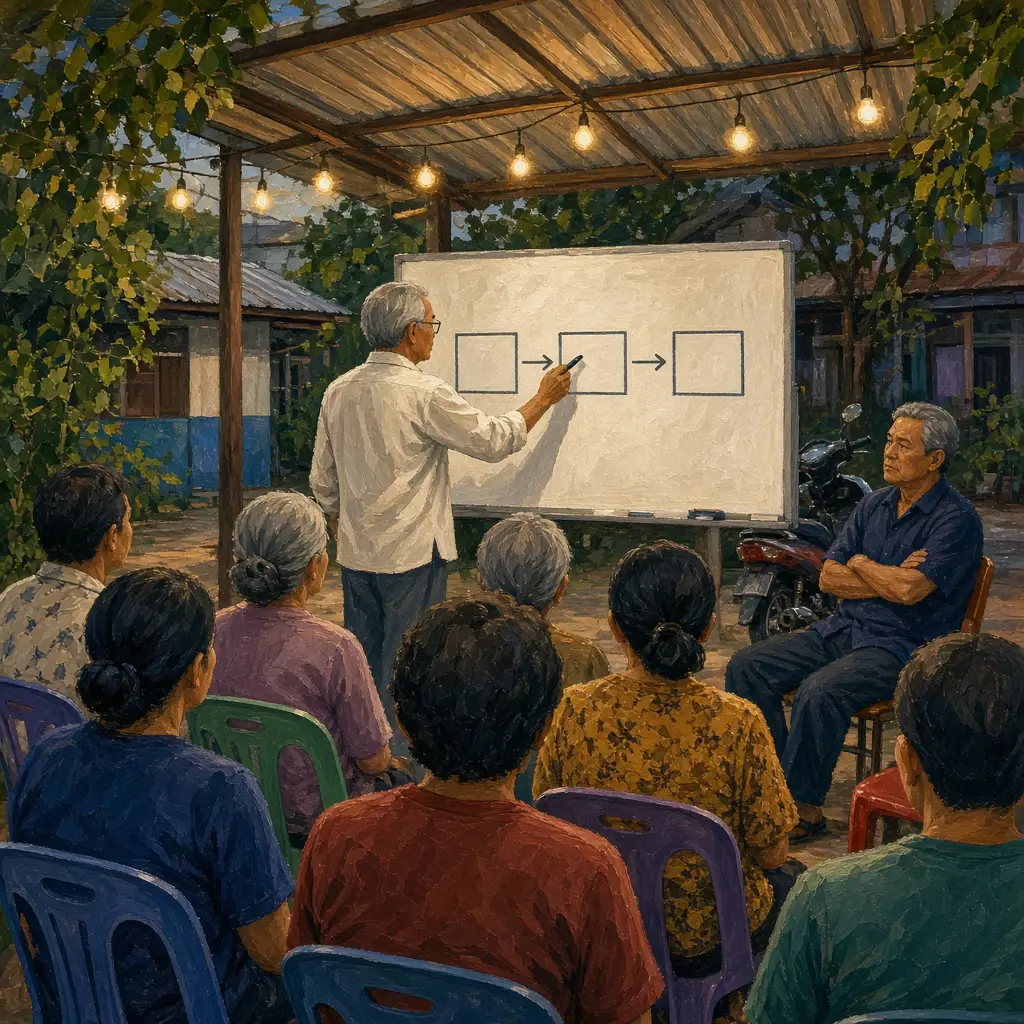
For years the chairman of a housing cooperative in Chiang Mai wrote the house rules, collected the fines and heard any appeal against them. When he fined a family for leaving a motorbike in the courtyard, under a rule he had added that same week, they appealed to him, and lost. At the next general meeting Malee, a retired schoolteacher, was asked to redraft the rules.
She split the jobs. The meeting of all households would make rules, the chairman would apply them, and a panel of three residents drawn by lot would hear appeals. Then she gave each part teeth. The panel could cancel a fine, the chairman could send a new rule back to the meeting once for a second vote, and only the meeting could set the monthly fee. A neighbour complained that a parking dispute now took three weeks to settle. Malee agreed that it did. That, she said, was the price of nobody being able to fine you under a rule written that morning.
Try this today Pick one rule you live under, at work or at home. Who wrote it, who enforces it, and who would hear your complaint?
Cite or share this lesson
A plain reference you can paste into notes or an essay:
Quest2Order. “Montesquieu's Three Powers.” https://quest2order.com/learn/lesson/montesquieu-spirit-of-the-laws. Accessed 29 November 2026.
Sources
- Montesquieu — Stanford Encyclopedia of Philosophy on his life, his definition of liberty and his separation of powers.
- The Spirit of the Laws — The book's structure and its long discussion of the English system.
- Separation of powers — The idea from Montesquieu to modern constitutions, and fusion of powers as its contrast.