
Lesson · 6 min Stretch
Government From the Chamber
In one line In a parliamentary system the government grows out of the chamber and lasts only while the chamber backs it.
In a parliamentary system the executive is born from the legislature. Voters elect a chamber; whoever can command a majority there forms the government; and the government lasts only as long as that majority holds. Montesquieu had praised England for separating its powers, as the lesson Montesquieu's Three Powers showed, and Walter Bagehot replied a century later that its real secret was the opposite. He called this the nearly complete fusion of the executive and legislative powers, with the cabinet as the link.
The best-known versions differ in detail. In Britain ministers sit in Parliament, and a government that loses the confidence of the Commons must go. India wrote the rule down: its constitution makes the council of ministers collectively responsible to the Lok Sabha, and a minister who belongs to neither house must win a seat within six months or leave office. Germany's Bundestag formally elects the chancellor, and can remove one only by electing a successor, a rule this week returns to.
Fusion buys speed and clarity. A government with a majority can pass its budget and its laws without bargaining with a rival branch, and voters know whom to blame. It costs checks. In 1976 the British politician Lord Hailsham warned that a government with a firm majority and loyal backbenchers had become an elective dictatorship, limited mainly by the date of the next vote.
So fused systems look for checks elsewhere. Germany has a federal upper house and a strong constitutional court; India has its states and a Supreme Court that can strike down laws; Britain leans on the House of Lords, committees, the courts and an official opposition. Whether these are enough, or whether Montesquieu's fear is only postponed until a large majority arrives, is the argument fusion has never settled.
One chamber, no brakes
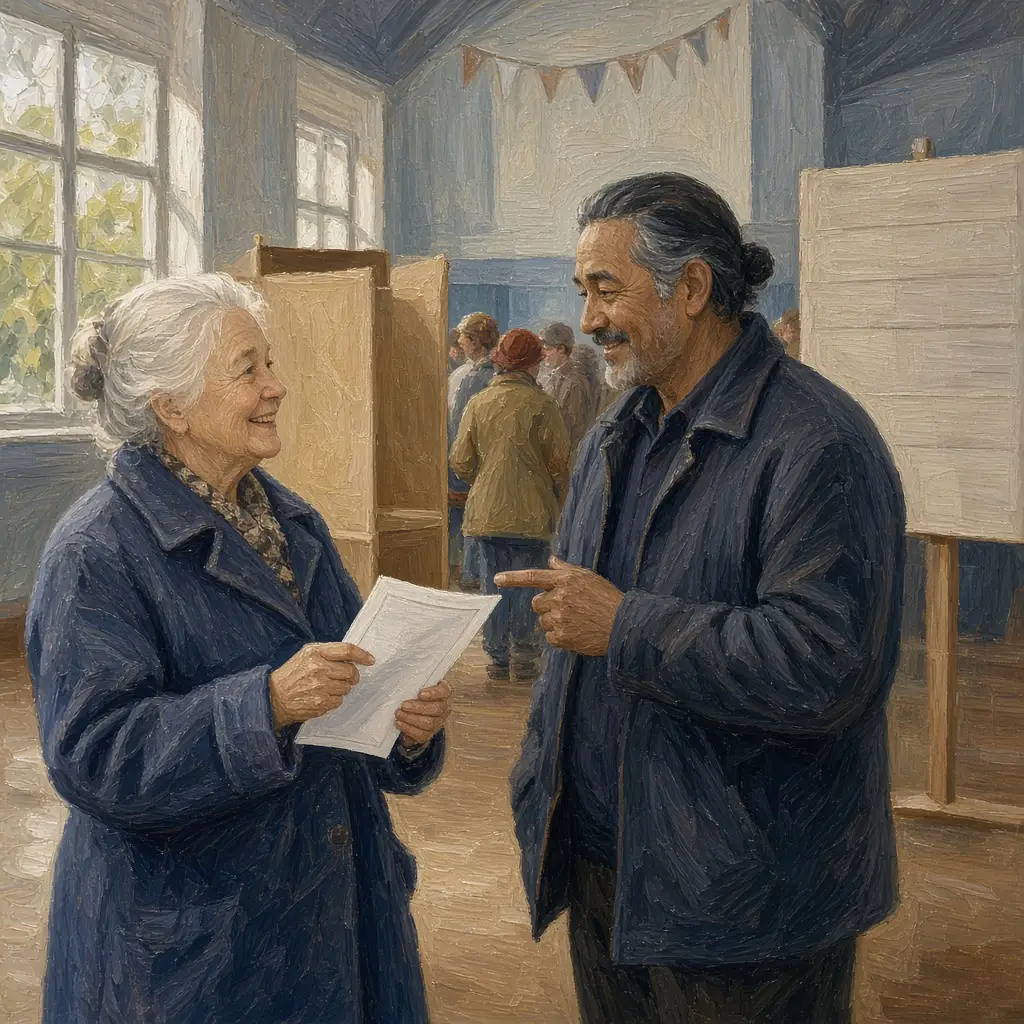
Joan was a young clerk in the Parliament buildings in Wellington when New Zealand's upper house, the Legislative Council, was abolished at the end of 1950. From then on the country had a single chamber. A government with a majority there faced no second house, no states and no written constitution that judges could use to strike down its laws. Over the years Joan watched bills she thought rushed pass in a matter of days.
In 1993, long retired, Joan queued at her local school to vote in a referendum on a new electoral system that would make single-party majorities rare. Her neighbour Rawiri asked why she bothered, since the old system gave strong governments that got things done. Joan said that was exactly the trouble. Rawiri said it was exactly the point, and they walked home still arguing about it.
Try this today Count how many members of your national government also sit in the legislature that is meant to check them.
Cite or share this lesson
A plain reference you can paste into notes or an essay:
Quest2Order. “Government From the Chamber.” https://quest2order.com/learn/lesson/parliamentary-fusion-of-powers. Accessed 29 November 2026.
Sources
- Fusion of powers — Bagehot's term, the Westminster model and India's parliamentary system.
- Elective dictatorship — Lord Hailsham's phrase, popularised in his 1976 Richard Dimbleby Lecture.
- Article 75, Constitution of India — Ministers appointed on the prime minister's advice and collectively responsible to the Lok Sabha.