
Lesson · 6 min Stretch
The Policy Cycle
In one line The policy cycle maps a problem's path from agenda to evaluation, though real policy rarely moves in order.
In 1956 the American political scientist Harold Lasswell, who had earlier summed up politics as who gets what, when and how, published a short study of the decision process. He broke it into seven functions, from gathering intelligence and promoting ideas to prescribing rules, applying them, ending them and appraising the result. Later textbook writers trimmed his list into a cycle of five stages that is still taught everywhere: agenda setting, formulation, adoption, implementation and evaluation, with evaluation feeding back into a new agenda.
The cycle is a map, and its first use is to locate a policy. Is a problem still trying to get noticed, or are officials drafting options? Has a law passed but not yet reached the street? Each stage also has its own pen holders. Journalists, campaigners and crises shape the agenda; civil servants and experts draft; ministers, legislatures and sometimes courts adopt; agencies and front-line staff implement; auditors, researchers and committees evaluate. Knowing the stage tells a citizen where a letter or a submission can still make a difference, and where it comes too late.
Critics say the map is tidier than the ground. Charles Lindblom argued in 1959 that officials rarely start from goals and work forward; they muddle through by small steps, adjusting what already exists. Others found solutions waiting for a problem to attach to. Paul Sabatier called the stages a heuristic, a handy way to divide the subject rather than a theory of what makes policy change. Real policy loops, skips stages and sometimes runs backward, as when trouble in delivery reopens the agenda.
This week follows the cycle stage by stage while keeping the critics in view. The map is worth carrying, as long as nobody mistakes it for the road.
Five boxes in a circle
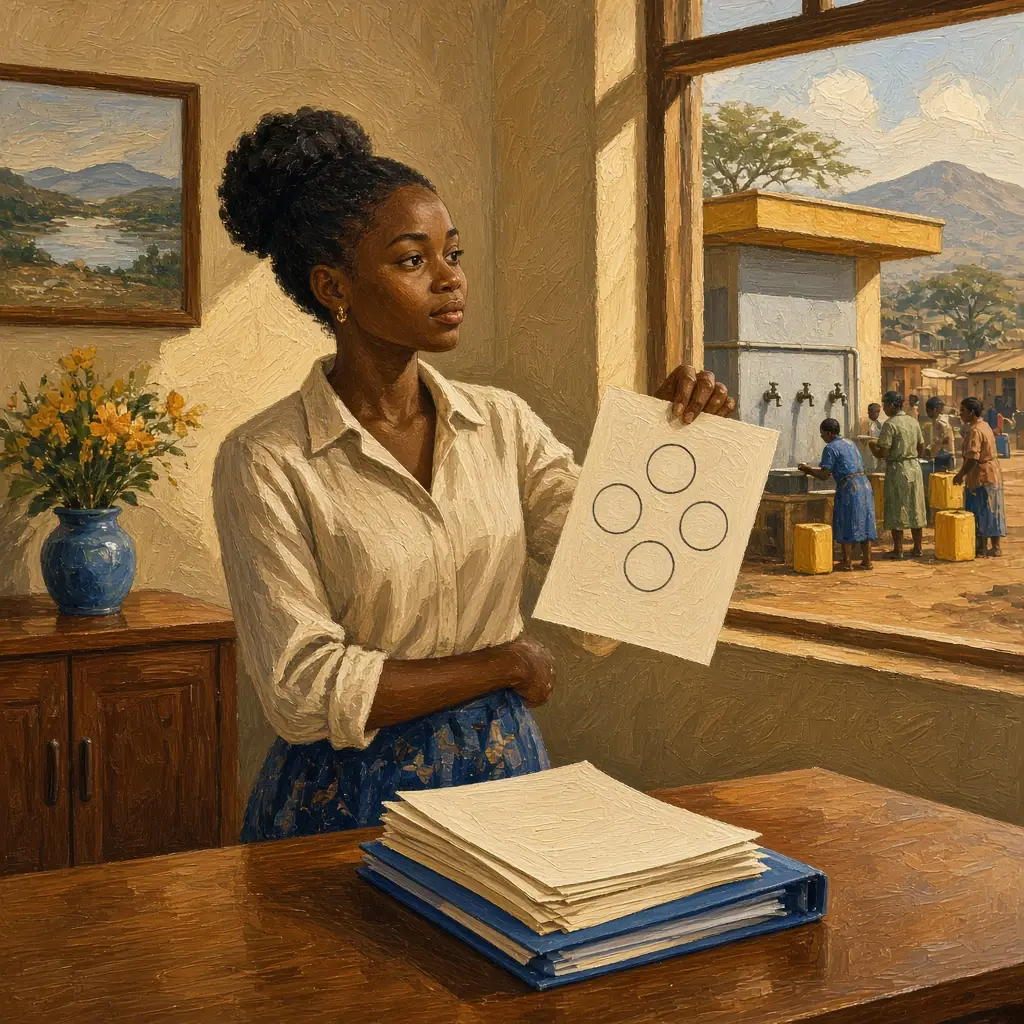
Wanjiku, a new aide to a county assembly member in Nakuru, was handed a thick folder on her first morning. It held every paper the county had on public water kiosks: a petition from an estate where the taps ran dry three days a week, a draft bylaw from the water department, a budget line approved last year, and a complaint that the kiosks already built charged more than the bylaw would allow.
She took a sheet of paper and drew five boxes in a circle. The petition went in the first box, the draft in the second, the budget vote in the third, the overcharging complaint in the fourth. The fifth stayed empty: nobody had ever checked whether the existing kiosks had helped anyone. The folder, she saw, was not one policy at one stage but several at different ones. She wrote a name beside each box, the person who held the pen there, and took the sheet to her boss.
Try this today Pick one rule in the news this week, decide which stage of the cycle it has reached, and name who holds the pen there.
Cite or share this lesson
A plain reference you can paste into notes or an essay:
Quest2Order. “The Policy Cycle.” https://quest2order.com/learn/lesson/policy-cycle-as-map. Accessed 29 November 2026.
Sources
- Harold Lasswell — Lasswell's life and his 1956 seven-stage account of the decision process.
- Policy — The five-stage policy cycle, its origins and Sabatier's criticism of stages models.
- Charles E. Lindblom — Lindblom's 1959 article on muddling through and the theory of incrementalism.