
Lesson · 6 min Stretch
Smith's Three Duties
In one line Smith gave the sovereign three duties, so his question was never market or state but which tasks belong to each.
Adam Smith is often cast as the enemy of government. Read The Wealth of Nations (1776) to its fifth book and a different figure appears. Under what he called the system of natural liberty, the sovereign has three duties. The first is to protect the society from violence and invasion by other societies. The second is to protect each member from injustice by any other, through an exact administration of justice. The third is to build and keep up the public works and institutions that no individual could profit from providing, though they repay a whole society many times over.
Smith did not leave the third duty vague. Roads, bridges, canals and harbours belong to it, and he argued that most could be kept up by small tolls on those who use them, so that each user pays in proportion to the wear he causes. Education belongs to it too. He warned that the division of labour, which made nations rich, could leave a worker who repeats a few simple tasks all day dull and ill-informed, and he praised the parish schools of Scotland, which had taught almost the whole common people to read.
Even there his method shows. The public, he said, should pay the schoolmaster partly but not wholly, or the master would soon neglect his work. For each task Smith asked two questions: can the market supply it, and if the state must, how can those who run it be kept diligent? He wanted judges safe from the executive's whims for the same reason. His four rules for taxes, met in Kinds of Taxes, come from the same book.
So the question Smith left was never market or state. It was which tasks belong to each, and how to make each do its share well. The rest of this week follows the economists who tried to turn his list into a test.
A bridge and a reading teacher
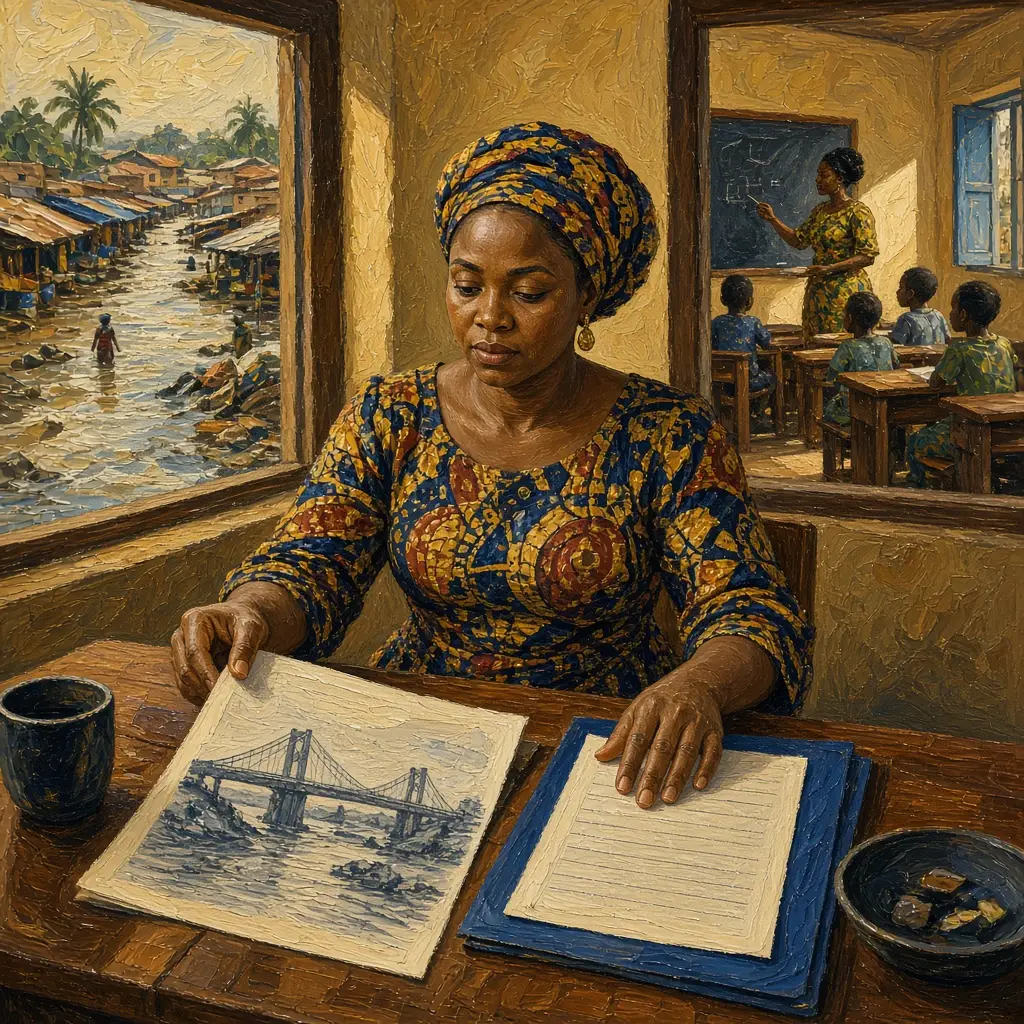
Zainab is the district engineer in Tamale, in northern Ghana, and two requests sit on her desk. A private firm offers to build a bridge over the stream that floods the market road each rainy season, if it may collect a toll from every lorry that crosses. A head teacher asks the district to pay for a second reading teacher, since half her pupils leave school able to sign their names and little more.
Zainab sorts them as Smith might have. The lorries carry yams and cement to market, their owners profit from the crossing, and a toll charged by weight would fall on those who wear the bridge most. She drafts terms letting the firm collect it, with walkers and bicycles free and the fee capped by the assembly. The reading teacher is another matter. No firm will profit from a nine-year-old learning to read, yet the whole district will. She puts the teacher in the district budget, and asks the school to report each year how many pupils can read a page aloud.
Try this today Pick one service on your street and ask Smith's question: could anyone profit from providing it, and if not, who should?
Cite or share this lesson
A plain reference you can paste into notes or an essay:
Quest2Order. “Smith's Three Duties.” https://quest2order.com/learn/lesson/smith-duties-of-the-sovereign. Accessed 29 November 2026.
Sources
- The Wealth of Nations, Book V, chapter 1 — Smith on the expenses of the sovereign: defence, justice, tolls for public works and the Scottish parish schools.
- Adam Smith's Moral and Political Philosophy — Stanford Encyclopedia of Philosophy entry, including Smith's view of the state's tasks beyond justice.
- The Wealth of Nations — Overview of the book's five parts and its case for education and a judiciary.