Lesson · 6 min Steady
Many Socialisms
In one line Socialism named many routes to equality, through cooperatives, unions, taxes, parliaments and revolution, often at odds.
The word socialism came into use in Britain and France in the 1820s and 1830s, before Marx wrote a line, and it named a family of hopes more than a plan. Its members shared a complaint: that the new industrial order made a few rich and many poor, and that work could be organised differently. On how to change it, they disagreed sharply.
Some built small worlds of their own. Robert Owen, a Welsh-born mill owner, ran the cotton mills at New Lanark in Scotland from 1800 as a model community, with shorter hours, better housing and Britain's first infant school, then sank much of his fortune into a commune at New Harmony in Indiana that soon broke up. In France, Charles Fourier designed communities where people would rotate through work they found attractive; dozens were tried, mostly in America, and few lasted. In 1844 weavers in Rochdale opened a shop owned by its customers, whose rules became a model for cooperatives across the world.
Others looked to the state. The Fabian Society, founded in London in 1884 and named after a Roman general famous for patient delay, worked for gradual reform through research, local councils and parliament. In Sweden, social democrats who had once spoken of class struggle won office in 1932 and held it almost without a break until 1976. They built a welfare state they called the people's home, and left most industry in private hands, regulated and taxed rather than owned.
These routes often fought one another. Marx and Engels dismissed Owen and Fourier as utopians whose islands could not survive a hostile economy. Revolutionaries called reformers traitors who propped up capitalism; reformers saw revolutionaries as a threat to the democracy that let workers vote. Which route served equality best, and at what price, is still argued.
The pay cap vote

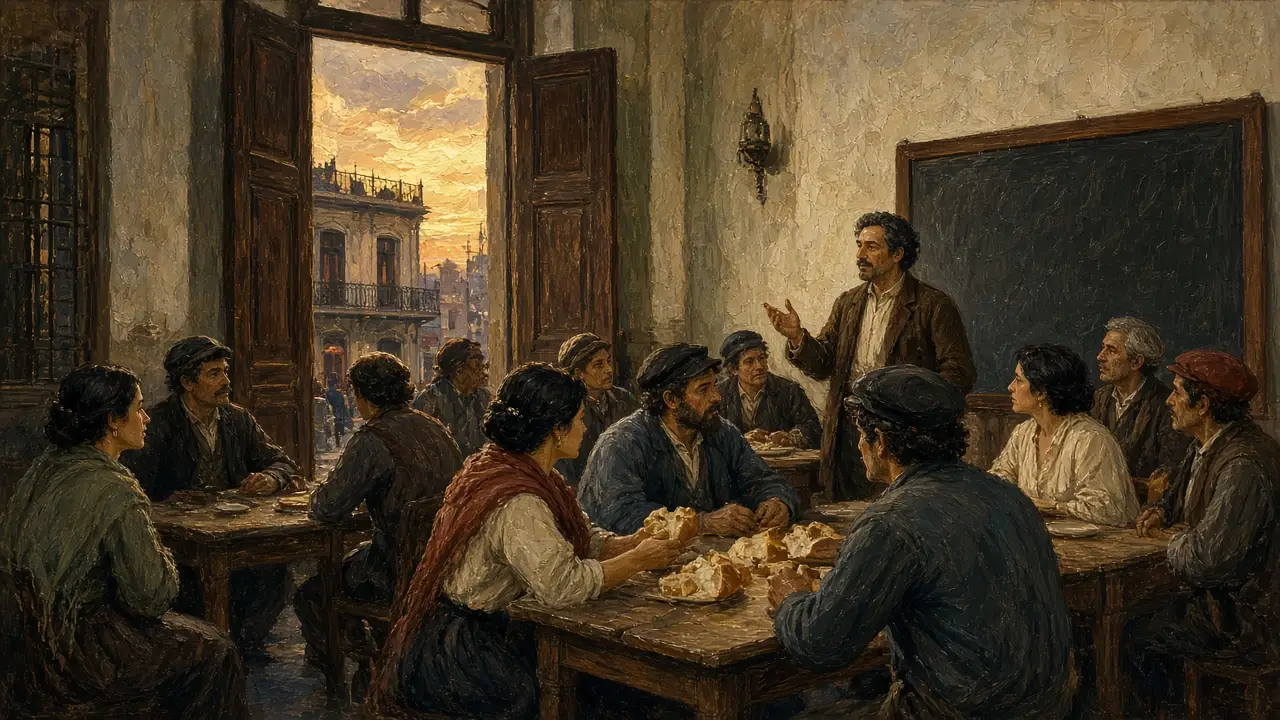
In the 1960s Itziar works on the line at a cooperative in Mondragón, in the Basque Country, that makes cookers and heaters. She paid an entry fee, lent to her by the cooperatives' own bank, to become a member, and with it came a vote. Once a year the members meet in a general assembly, elect a governing council and decide how much of the profit goes into each member's capital account.
This year the hot question is pay. The rule is that nobody earns more than three times the lowest wage, but a skilled engineer has been offered far more by a private firm in Bilbao. Itziar's neighbour says the cap is the whole point of the place. A younger member answers that they will lose their best people, and then everyone's jobs. Itziar votes to keep the cap but asks for it to be reviewed, knowing a cooperative must survive in a market it did not choose.
Try this today Find a cooperative near you, a credit union, a farm co-op or a shop, and learn who owns it and how its members vote.
Cite or share this lesson
A plain reference you can paste into notes or an essay:
Quest2Order. “Many Socialisms.” https://quest2order.com/learn/lesson/socialist-traditions-before-marx. Accessed 29 November 2026.
Sources
- New Lanark — Robert Owen's mill village, its infant school and the New Harmony venture.
- Fabian Society — Its founding in 1884, its name and its strategy of gradual reform.
- Mondragon Corporation — The Basque federation of worker cooperatives, its founding and its pay ratios.