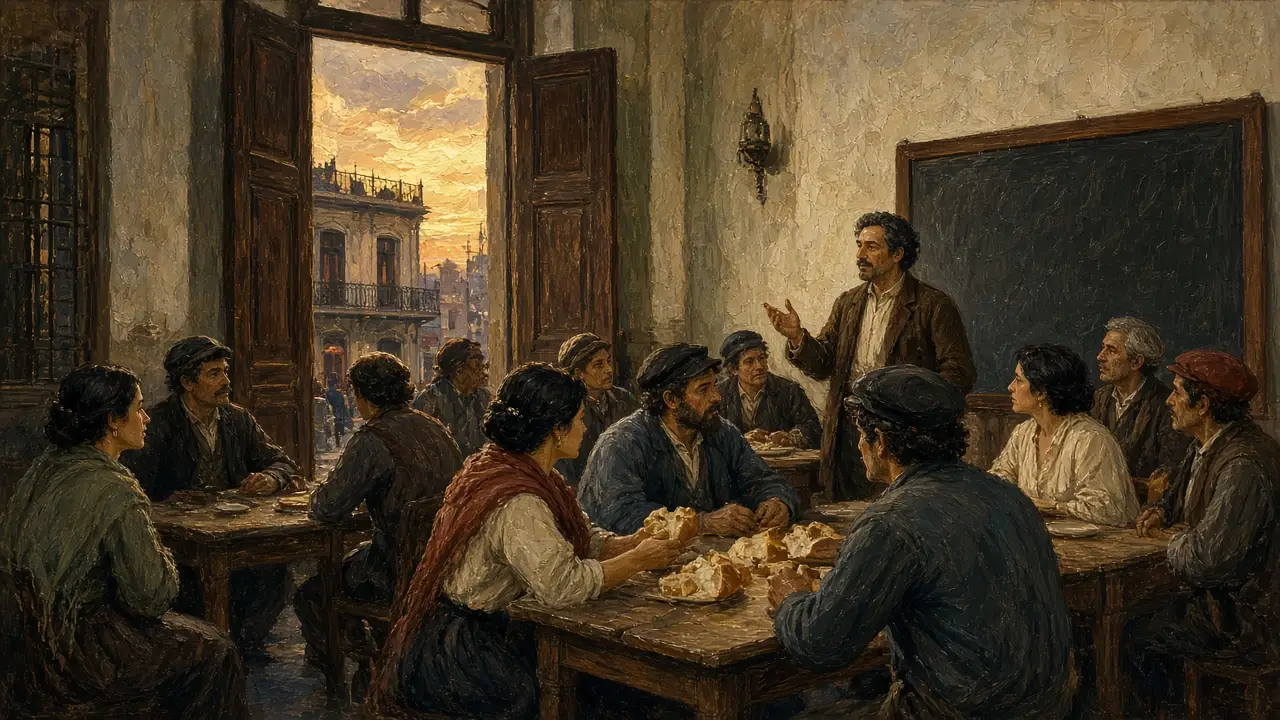
Lesson · 6 min Steady
Tawney's Equality
In one line Tawney argued that equality means removing inherited advantage, not sameness, so that liberty can be widely shared.
R. H. Tawney was born in Calcutta in 1880, taught evening classes for the Workers' Educational Association in the Potteries and Lancashire, and became a historian at the London School of Economics. His book Equality (1931) is a classic case for equality made inside a liberal democracy.
Tawney did not think people equal in talent, nor want everyone to earn the same or live alike. What he attacked was inequality that comes from birth rather than effort: inherited fortunes, schools that sorted children by their parents' purses, and the power of employers over people with no other way to live. Natural differences should be free to show themselves; it is the artificial ones society adds that a decent community should remove. A chance to rise means little, he argued, to people kept from using it.
Against those who set liberty against equality, he argued that liberty means being able to act on one's choices, and so depends on power. Where some hold great economic power over others, the freedom of the strong is bought with the freedom of the weak, an idea summed up in a line often credited to him: freedom for the pike is death for the minnows. His remedy was not equal pay but common provision: good schools, health care and housing open to all, paid for by taxes, so that people meet as equals whatever they earn. Equality, for Tawney, was a condition of fellowship.
This makes him the fair opposite number to Hayek: Prices Know More. Hayek feared that a state strong enough to equalise would be strong enough to dominate. Tawney replied that private power already dominates, and that a democracy can share basic goods without fixing anyone's wage. Critics answer that public services can be slow and uniform, that high taxes blunt effort, and that levelling can lower the top without raising the bottom.
Go deeper
Tawney's sharpest image is his mockery of what he called the tadpole philosophy. Most tadpoles, he wrote, will live and die as tadpoles, but they may console themselves that a lucky few will shed their tails, hop onto dry land and lecture their old friends on how tadpoles of character and capacity can rise to be frogs. His target was the idea that a ladder of opportunity, climbed by a gifted few, makes up for the conditions everyone else is left in. Defenders of opportunity reply that a ladder is better than none, and that a society which rewards climbing gives everyone a reason to try.
The ration shop counter

In the 1970s Leela runs the ration shop in a village near Kollam, in Kerala. Every family, landowner's or labourer's, holds a card and queues at her counter for rice at the same fixed price. The village school, the health centre and the reading room down the road are open to all of them too. Kerala is far from rich, yet its people read and live longer than in most of India.
One morning the landowner's wife and the wife of a man who works his fields stand together in the queue, then sit on the same bench at the clinic. Leela notices that they talk as neighbours, which their mothers would not have done. Her brother, home from work in the Gulf, grumbles that the queues are long and the rice is poor, and that people with money should buy better elsewhere. They can, Leela answers, and some do. The question is what the shared counter is for.
Try this today List three things your town provides for everyone alike, such as a library, a clinic or a park, and ask who would lose most without them.
Cite or share this lesson
A plain reference you can paste into notes or an essay:
Quest2Order. “Tawney's Equality.” https://quest2order.com/learn/lesson/tawney-equality-and-fellowship. Accessed 29 November 2026.
Sources
- R. H. Tawney — His life, his teaching for the Workers' Educational Association, The Acquisitive Society and Equality.
- Egalitarianism — Stanford Encyclopedia of Philosophy on the forms of egalitarianism, the levelling-down objection and relational equality.