
Lesson · 6 min Stretch
Who Runs the Schools?
In one line Federations split schools and police in different ways, trading uniform standards against local fit and control.
The two services most people meet are the school and the police, and there the principle of subsidiarity, which the lesson Closest to the Problem explained, becomes concrete. Federations answer very differently. In Germany, education belongs to the sixteen Länder. Each sets its own curriculum, school types and final examinations, and primary school lasts four years in most Länder but six in Berlin. The federal government has no general power over schools, and the Länder education ministers meet in a standing conference to keep their certificates mutually recognised. Canada goes further: it has no federal education ministry at all, and each province runs its own system.
India chose a shared answer. Its constitution first placed education with the states, but an amendment of 1976 moved it to the concurrent list, where both Parliament and the states may make law. Where the two conflict, the national law normally prevails.
Policing, set out in Two Forces, One Country, shows a similar spread. Nigeria's constitution provides one police force for the whole federation, while Germany's Länder run their own. Canada splits it three ways. Many cities have their own forces; Ontario and Quebec have provincial police; and the federal Royal Canadian Mounted Police is hired by contract to act as the provincial force everywhere else and to police many smaller towns.
What does each choice buy? Central rules give uniform standards and let a family move across the country without a child falling behind. Regional rules give local fit, schools in the community's own language, and room to experiment: one region tries a reform and the others watch. In policing the trade is between national reach, which follows crime across borders and resists local capture, and local accountability, which puts officers under people who can vote their bosses out. No federation has settled the balance for good, and most adjust it every generation.
Back to primary
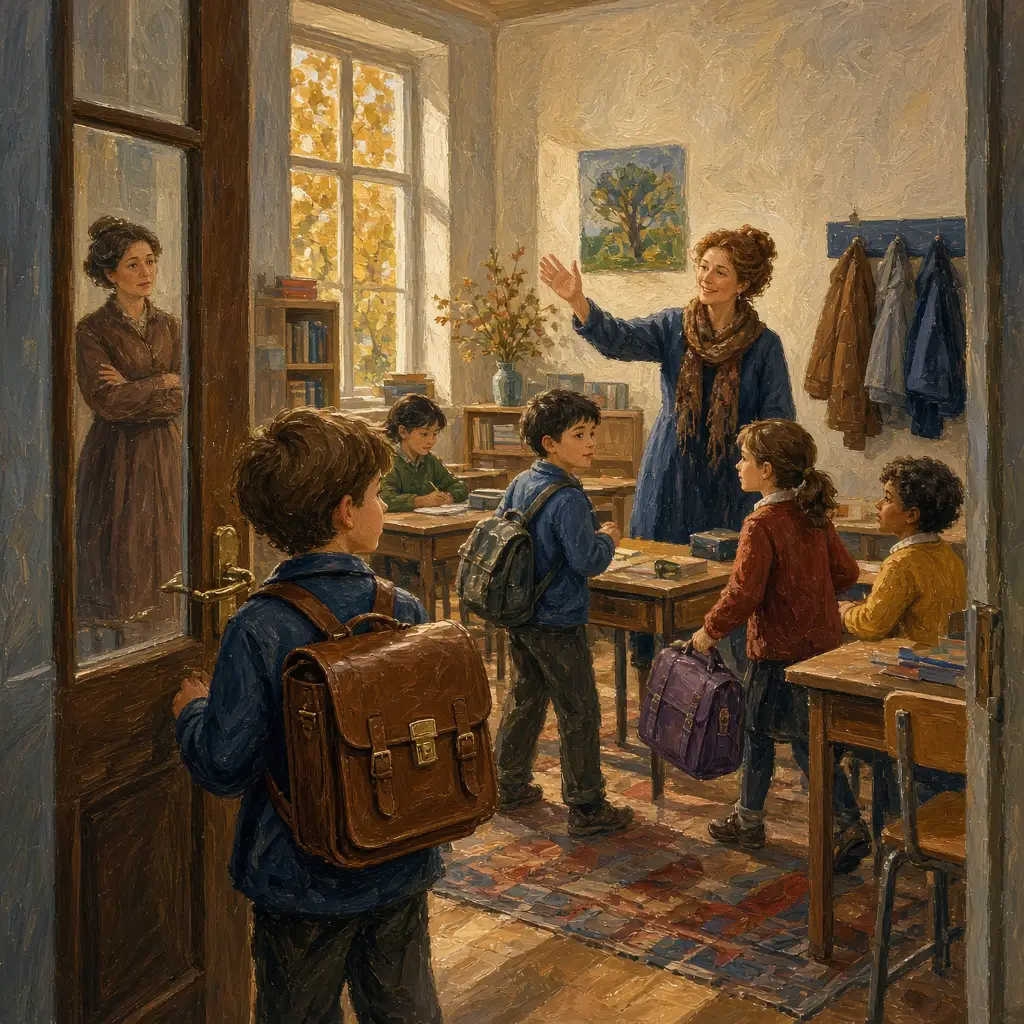
When Elif took a job in Berlin, her son Deniz had just finished the fourth year of primary school in Munich. In Bavaria that is the moment of decision. His marks had earned him a place at a Gymnasium, the academic secondary school, and his grandparents had already bought him a new school bag for it.
In Berlin, primary school lasts six years. The school office told Elif that Deniz would usually go back into a primary class, with the Gymnasium question settled two years later. She was furious for a week. Then she met his new teacher, who had a mixed class and a plan for keeping Deniz stretched, and a neighbour who said Berlin had chosen the longer primary on purpose, to delay sorting children by ability. Elif still thought one country should have one school system. Deniz, who liked his new friends, did not much mind either way.
Try this today Find out who sets the curriculum in your local school: the nation, a region or the school itself.
Cite or share this lesson
A plain reference you can paste into notes or an essay:
Quest2Order. “Who Runs the Schools?.” https://quest2order.com/learn/lesson/who-runs-schools-and-police. Accessed 29 November 2026.
Sources
- Education in Germany — The Länder's responsibility for schools and the differences between their systems.
- Concurrent List — India's shared list of powers and the subjects, including education, moved to it in 1976.
- Royal Canadian Mounted Police — The RCMP's contract policing in provinces, territories and municipalities.