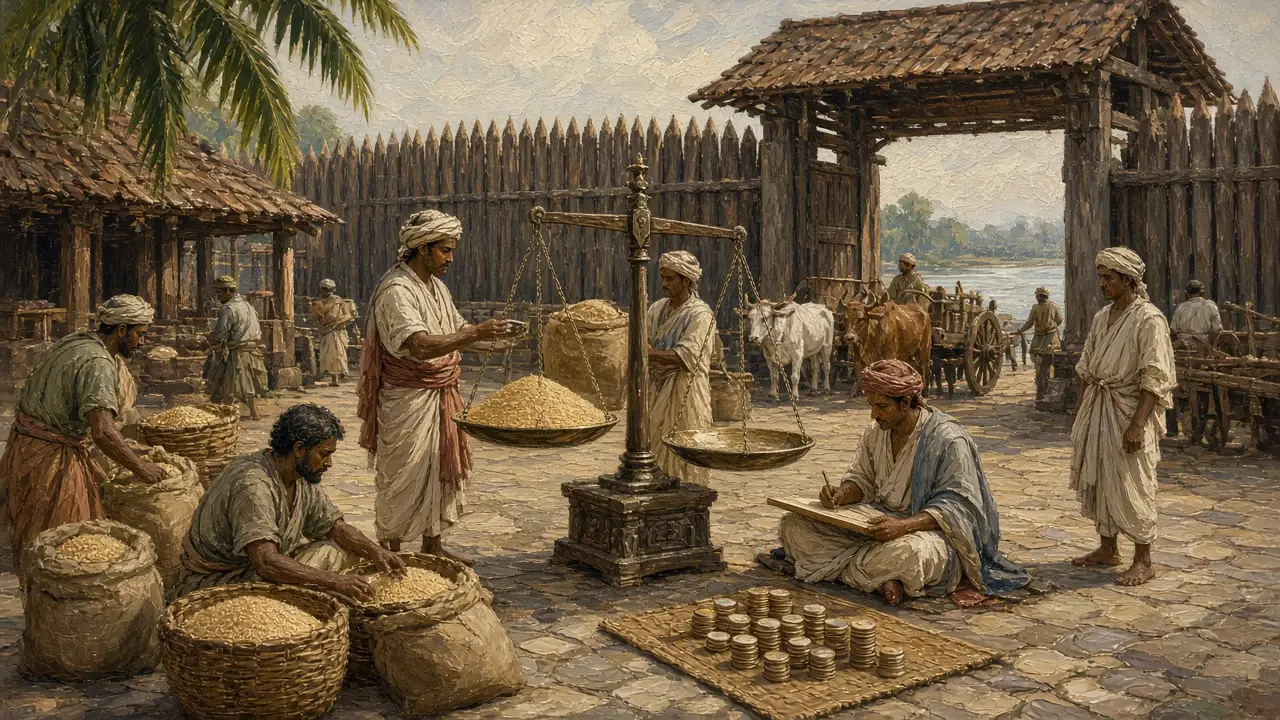
South Asian statecraft · 4th century BCE onward
The Arthashastra tradition
Overview
Statecraft is a science of power and prosperity, to be studied as coolly as any other. Kautilya’s Arthashastra lays out how a king should tax, spy, ally and fight; Ashoka’s edicts answer with an ideal of rule by dharma and compassion, and Manu’s lawbook binds the king within a sacred order.
The Arthashastra tradition is the Indian science of statecraft, named for the Arthashastra, a manual attributed to Kautilya, the minister credited with bringing Chandragupta Maurya to power around 321 BCE. The text we have was probably compiled and revised over several centuries and then lost, surviving only in a manuscript rediscovered in 1905. Around it stands a wider literature: the rock edicts in which the emperor Ashoka, Chandragupta’s grandson, set out a very different ideal of rule by dharma after his conversion to Buddhism, and the Manusmriti, the lawbook attributed to Manu, which fixed the duties of kings within a sacred order of castes and life stages.
Read more (2 more paragraphs)
Kautilya’s subject is artha, material prosperity and power, and his question is how a king keeps and enlarges a state. He describes the state as seven limbs, the saptanga: ruler, ministers, territory, fortified capital, treasury, army and allies. He treats foreign policy through the mandala, a circle of neighbouring states in which your neighbour is your natural enemy and your neighbour’s neighbour your natural friend, and lists six methods from peace to war. Danda, the rod of punishment, is what holds society together, yet he insists it be measured, since a king who punishes too harshly or too lightly is despised. He details taxation, spies, price control and the daily timetable of a ruler, and declares that the king’s happiness lies in the happiness of his subjects.
Critics within the tradition came first. Ashoka’s edicts renounce conquest, ask officials to rule with compassion and call for tolerance between sects, a standing answer to the cold calculation of the Arthashastra. The Manusmriti subordinates the king to Brahmin authority and to a caste order that modern Indian reformers, Ambedkar above all, condemned as the charter of hereditary inequality. Later readers have accused Kautilya of amoralism and of treating spies and assassination as routine tools, and the comparison with Machiavelli is now a commonplace. Admirers answer that he wrote for a world of permanent war and still judged kings by the welfare of their people. The habit worth keeping: count a government’s treasury, allies and borders as carefully as its ideals.
Where it answers
Who should decide?
The king decides, counselled by ministers and informed by spies, judging each matter by what strengthens the treasury, the army and the realm.
Why obey?
Rules are obeyed because the king's rod of punishment keeps the strong from devouring the weak, and that order is what lets people prosper.
What is freedom?
Freedom is the security a strong and well-run state provides: fields that are not raided, roads that are safe and courts that answer.
What do we owe strangers?
A king owes his own subjects everything and his neighbours only what the circle of alliances requires; the stranger is first a question of security.
See how other traditions answer “What do we owe strangers?” →
Key terms
- Artha
- Material wealth and power, one of the goals of life; the science of acquiring and keeping it.
- Danda
- The rod of punishment; coercion, used in measure, as the basis of order.
- Mandala
- The circle of states around a kingdom, read as natural enemies and natural friends.
- Dharma
- Right conduct and duty; Ashoka’s standard for rule and the frame of Manu’s lawbook.
- Saptanga
- The seven limbs of the state: ruler, ministers, territory, capital, treasury, army, allies.
In their words
“In the happiness of his subjects lies his happiness; in their welfare his welfare.”
Further reading
- Arthashastra · Kautilya
- Edicts of Ashoka · Ashoka
- Manusmriti · Attributed to Manu
Learn this
Compare
Cite or share this page
A plain reference you can paste into notes or an essay:
Quest2Order. “The Arthashastra tradition.” https://quest2order.com/learn/ideas/arthashastra. Accessed 29 November 2026.